
 Banksy, according to hearsay, is the son of upper-middle class parents, a native of Yate (near Bristol) and is nearing his forties in age. The British public is particularly inquisitive about his identity, even sicking the Daily Mail on the home of the man they believe to be Banksy. Much of this is fueled by the anonymous persona adopted by Banksy to allude arrest. If captured, he could face imprisonment for a lifetime of work, including tagging the Palestine wall (left), switching the Mona Lisa with a fake bearing a garish smiley face and tagging zoos.
The Metropolitan Police continue to embrace the ineffective CCTV surveillance units scattered around London. A lot of Banksy's graffiti addresses the loss of spatial freedom as a result of technological advance. If he were apprehended, he would face considerable legal ramifications despite the fact that he has paradoxically accrued millions selling through one art dealer and maintaining a hidden identity.
The Metropolitan Police's crackdown last year that was discussed in the first post resulted in one of Banksy's murals that said, "One Nation Under CCTV" being painted over. If a statement in a public place critiquing the policies of a government is erased by a police force that spends billions to clean up graffiti, then that is censorship. Whether or not you believe that the aesthetics of graffiti qualify as art, its political implications are astounding.
Banksy made one of his most important pieces when he tagged the Segregation Wall in spots near Qalqiliya, Bethlehem, Abu Dis and Ramallah. He painted several large pieces on the twenty-five feet high prison wall. He generated a broad spectrum of reactions ranging from anger to world-wide press. Some settlers thought it glamorized what is essentially the deprivation of these individuals from their land. For example, in the piece pictured at the top of this page, one can see smiling kids playing under palm trees. Considering Palestinian settlements often face disastrous water shortages, that scenic view is a mirage and reflects a heritage unrealized. The existence of the walls themselves and the vision of life within is not typically discussed in mainstream news.
Tagging the Segregation Wall is not the same as the graffiti that extensively covered the Berlin wall. For both political states, there could be no clearer metaphor for socioeconomic division than a giant cement wall that cuts through the communities. In Israel the settlement is so tightly guarded that there is only one entrance and graffiti previous to Banksy seemed unfathomable. Sibilant guards occupy the watchtowers and patrol the settlements with guns, kicking at the dust, heat, spindly gnats.
The architectural markers of the community are vital to the citizens' construction of national and religious identity. Imagine how the pace of life would change if traffic flow of 100,000 people were mitigated to one entrance. Tagging the surface of the Segregation Wall is a means to challenge its permanence.
In his book Wall and Piece, Banksy talks about the journey to Israel and the dangers and public reactions he faced while tagging the wall. He recounted the following exchanges and viewpoints on his website:
Soldier: What the fuck are you doing?He later wrote,Me: You'll have to wait til it's finished
Soldier (to colleagues): Safety's off
How illegal is it to vandalize a wall if the wall itself has been deemed unlawful by the International Court of Justice? The Israeli government is building a wall surrounding the occupied Palestinian territories. It stands three times the height of the Berlin wall and will eventually run for over 700km - the distance from London to Zurich. The International Court of Justice last year ruled the wall and its associated regime is illegal. It essentially turns Palestine into the world’s largest open-air prison.
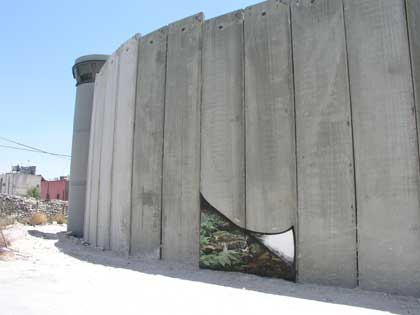 The idyllic scene pictured above and sprayed while under observation of the nearby gun tower offers a glimmer into acknowledging the livelihood of those trapped inside the Segregation Wall. Obviously, if the wall could be swept up as if it were a rug, the scene would not reveal an illustrious forest and babbling brook. You would probably see garbage, rubble and debris worse than the area in focus just to the left of the tower.
The infamy of such endeavors has also helped Banksy land deals doing the album art for Blur (below), among other celebrities. He is capable of capturing the public's zeitgeist doing so in a commercially accessible fashion. In 2006, Christina Aguilera nabbed a copy of the Queen depicted as a lesbian and two other prints for a casual £25,000. Then, in 2007, one of his works sold for £288,000, which is over half a million US dollars. Angelina Jolie snagged some prints for £288,000. Banksy's Exit through the Gift Shop premiered at Sundance. To make a cloy pun, Banksy gets mad bank.
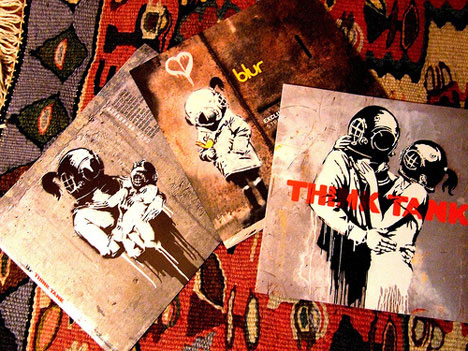
What's the problem with an artist who delivers a social message and actually gets paid for a quality product?
It's because there is no integrity in a gesture like hanging subverted artworks in MoMa, the Met and Brooklyn Museum when you have an enormously popular exhibit at the Bristol City Museum and Art Gallery. It's bad ass that Banksy strolls into galleries and nonchalantly hangs up his own work. However, he deplores the same museums and institutions in Wall and Piece as elitist, kultural manufacturing. Philosophy becomes a stunt when he then went on to display his own work. You could argue that this way he's getting a different message across in the galleries, but in actuality he's also generating revenue (crowds) to industries he allegedly despises.
This topic was broached when Banksy was featured as #129 on satirical site Stuff White People Like, which is basically like getting d-listed as an insipid producer of pop culture. Stuff White People Like disses Banksy on the grounds that he's not high faultin' enough and for the laypeople. The site points out that he's "anonymous, British, easy to understand, and he works in the medium of graffiti." On the contrary, Banksy's popularity gives him enormous potential as an artist in an incredibly visible position. Unfortunately, Banksy lost credibility because he became a commercial product and sold out. He destroys the intrinsic value of his own art by selling out to the highest bidders, a feat that contradicts the anti-capitalist ideals he expressed in graffito.

When speaking of Che Guevara in Wall and Piece, Banksy disclosed that he made the above piece because he didn't like these vendors who sold Che paraphernalia: mugs, t-shirts, fanny packs, etc. He wrote that he, "thinks [he] was trying to make a statement about the endless recycling of a cultural icon by endlessly recycling an icon." In other words, all the Che accessories denigrate the actual life of Che, the causes he supported and the alternatives he proposed. If you support Che or alternatives, buying a pencil case with their face on it is probably contradictory to their belief system. Right now, Banksy runs the risk of becoming some sort of graffiti mogul replete with gag gifts, customized license plates, or ironic tees. Graffiti does not belong in the gift shop at MoMA.
It should be a cityscape.


 Posts
Posts


No comments:
Post a Comment