"I was never starving," the driver said, "You can't see anything when you hit all the potholes in Queens"
Just as this structure exists, another:
there are cobalt blue thoroughbreds in cholera mountains
where Toussaint, houngans and other shamans marauded against the affidavits of circumstance
I heard Wyclef Jean placed a pleather presidential bid
In the circuit between historicity and tendency,
other prescient individuals passed on their skateboards
I don't even know what interests them
The hour has ever made it easier
to quietly leave the causes to the philanthropists
wearing ankle-high socks and girls who listen
take the q toward Coney Island
take the 3 to downtown new lots ave
hair pulled back rubberneck, a single strand
The cabbie ran three lights and turned up the timorous night game
I could almost see the spotlight on black, "Eh,
I kept my stomach wet" and we sat quietly with our
goods parsed in plastic bags
like bread banshees
The degree of intensity in color stems from
how much motion there is in filaments
You were speaking to me of tiny plankton in the iris
but tell the notary to put down the middle initial of my dad's name,
mention floating points, that the hue is pigeons and other small talk
When I have the ability to leave and come back
know it would only ever be a recidivism

28.10.10

3.8.10
(en)titlement

Writer and digital media presence Tao Lin is gifted with an ingenuous knack for inflection, uncanny self-promotional skills and the ability to harness the two together seamlessly. By twenty-five, Lin published a prolific amass of work including his first novel EEEEE EEE EEEE, the equally sensational Shoplifting From American Apparel and poetry- and shorts-collections.
In 2009, as Lin confirmed with David Nygren of The Urban Elitist, the author had already launched his own publishing house and acquired a large enough following to begin writing full time instead of stealing batteries to sell on eBay. On September 7th, 2010, Lin will release his next novel Richard Yates and probably resume his internet shenanigans.
Not surprisingly, Lin's non-traditional approach to new media and dry sense of humor inspires unparalleled hatred and fanboy devotion online. When Lin's piece, “An Account of Being Arrested for 'Trespassing' NYU's Bookstore,” was featured on Gawker, never has the usage of the word 'monotony' been so thoroughly debated:
 Or defended:
But, whether or not either analysis deserves credence is not the point. It's the strength and visibility of the reaction that demonstrates Lin's talent for eliciting response. Today's ephemeral intellectualism is obsessed with the placement of improvisational and suspensive hyphens (see: post-post-modernism). It is precisely this preoccupation with self-perpetuating dialogues that estrange academia from political relevance. At the cost of aesthetic narrative and traditional symbol-laden language, Lin employs stripped-down language lacking this pretension.
I think that Lin's own approach to the discerning narrative, as stated in an interview with Bookslut found here, elucidates more about his goals as a writer. When speaking of his controversial portrayal of race, Lin shared, “I know that 98% of all human beings think in preconceptions, clichés, and not factually... I try to view each person specifically, and only their concrete attributes.” His unflinching style is not unlike that of Laurie Moore or Amy Hempel.
II.
Long after I had read and unduly noted Shoplifting From American Apparel and Lin's poetry, I discovered Hipster Runoff. The smarmy yet insightful humor was best suited to my mood and desk job. When I later found out that Tao also contributed – the extent of which remains purposefully undefined – to Hipster Runoff/ the Alt Report, it was like one of those surprises that's so shocking because it makes perfect sense when viewed in retrospect. On a superficial level, Lin's writing has always spoke to me from the perspective of sarcasm, which remains the most readily digestible form of social critique.
I have been consistently amazed at how needed an accessible (via humor), anti-capitalist statement is on the radio paper. Not that surviving in a market economy is bad in a gotta-live-your-life sort of way, but because of the way that culture perpetuates social, racial and ideological achievement systems of discrimination. Academic discourse is the powerhouse publisher of this language. In a strange way, academia lacks the element of the Everyman factor that the ‘hipsterrunoffs’ facetiously (maybe?) celebrates (possibly?) as its aesthetic.
The tweenlight language of the site encourages of a type of accessibility missing in critical theory: the transmission of knowledge rather denial of this to maintain cultural isolation. Not that the site doesn't exist without paradox, seeing that it's besmirched with ads for American Apparel. It does, however, remain unclear how much bandwidth the site must support. All I know is that the culture industry will continue wresting with these concepts and inherent contradictions.
III.
Lastly, I don't expect to be able to uncover the level of meaning or amount of irony present within Tao Lin's writing. To write about 'who is Tao Lin' is so pedantic that the author himself has already mentioned it in scare quotes on his obnoxiously titled blog. Nor am I capable of conceptualizing him too far outside the realm of my own experience, ego and understanding.
I first picked up Shoplifting from American Apparel in St. Marc’s bookstore last summer, mostly on the basis of the title. Dimly, I picked up the book with a "Huh? This guy got arrested or something?" I had heard previously that AA condoned or treated shoplifters leniently. The suburban legend was that 'if you were cool enough to steal the clothes, then you were cool enough to wear them.' I don't have to tell you that was only an image.
Part of me didn't have to recall the friends I knew in Michigan who had actually been arrested for shoplifting from American Apparel to know that. And it's not like American Apparel is the only retail outlet that succeeds well with consumer ambivalence. The store attracts so much critique because its alternative marketing doesn't bode well with its targeted demographic. I use this store as one example to indicate how convoluted the relationship is between personal freedom and consumer choice.
In regards to Tao's book, I bought the book, forgot about it, read the book, read about it later, recommended it. But, I don't want to believe it's that simple. I also want to believe that something about the treatment of American Apparel in the phrase resonated with me. I had transferred to NYU and the only way I could describe how it was to my friends at home was, “It’s just like a commercial for American Apparel.”
In fact, that was a trite way to summarize my feelings while keeping the banter appropriately light, kind of like Lin's title. Tao Lin's pithy phraseology spoke to my confusion; he manages to speak of dissembling a culture while trying to exist amidst its internal disintegration. This is the most aware position an artist can take within society as such.
But, back to St. Marc's. The corner that the bookstore is located on is home to three Starfucks, fake rastas charging vendor paraphernalia and an exquisite Walgreen's on the former site of Astor Wines. Near the cube, there's enough noise to obscure the thought of anything registering aside from the stentorian squeals of horns and other sounds of sheer motion. Further down the street, past the real estate stakeholders, is a cemetery resting in quiet audacity. It was strange, being in a no-place like that and – and?
Something like existing with ambivalence.
19.6.10
Simulcra in the Visual Dictionary
TVD, or The Visual Dictionary, is a search-ready database that seems together the visual apex of words with a digital repository. Basically, it's users can upload a snapshot of words from signs, monuments or adverts, and these enter the site's catalog.

Since the project's inception in 2006, TVD users have uploaded 5,116 different words and 9,689 images. I browsed the stats section and was, at first, puzzled to find that "Madrid" is the most popular semiotic pairing with 43 contributions. It finishes before "Stop" (38), "Bar" (32), "Love" (28) and "The" (27). Madrid is probably frequently in the database because it's a prime tourist location and geolocational markers serve both as directional guides and to remind tourists, You are here.
What interests me is that there becomes something sacrosanct about the physical space and the fictive of travel, here with "Madrid," this concept is fused into a very physical space. It seems to say a fit about the formulation of anchor words in language, much like how "bar" and "love" have a variety of cultural and social roles and seem to pop up all over the place. In the case of these words, you can see how readily concepts can be compounded to into signs, or visual anchors, that convey a meaning at a cost-efficient character count.

Since the project's inception in 2006, TVD users have uploaded 5,116 different words and 9,689 images. I browsed the stats section and was, at first, puzzled to find that "Madrid" is the most popular semiotic pairing with 43 contributions. It finishes before "Stop" (38), "Bar" (32), "Love" (28) and "The" (27). Madrid is probably frequently in the database because it's a prime tourist location and geolocational markers serve both as directional guides and to remind tourists, You are here.
What interests me is that there becomes something sacrosanct about the physical space and the fictive of travel, here with "Madrid," this concept is fused into a very physical space. It seems to say a fit about the formulation of anchor words in language, much like how "bar" and "love" have a variety of cultural and social roles and seem to pop up all over the place. In the case of these words, you can see how readily concepts can be compounded to into signs, or visual anchors, that convey a meaning at a cost-efficient character count.
6.5.10
Fossils

"The drilling occurs at one mile below the surface of the ocean, but spilled oil floats on the 'skin of water,'" I hear on a podcast.
Suddenly, I'm again sitting at the kitchen table doing a science experiment about density when I was three. The terminology stuck: I remember the phrase 'skin of water.' I remember it despite the fact that I was lured into doing a science experiment; it really was masquerading as a game. My mom put a penny, feather and piece of paper on the table. She bet me that I could make a penny float like paper and one of those cheerfully-dyed costume feathers.
The paper and feather obviously floated, but I predicted that the penny would sink. She told me to first drop it in the cup, plop!, it went down. She then gave me some tweezers and told me to lower it in carefully because the skin of water, or the strong bonds between the atoms on the surface that cause surface tension would hold it up.
The overall slight charge of the element itself is most strong in the top layer. The top layer only interacts with the molecules below it, so it has a slightly greater charge that forms the skin of water. Gravity will try to pull an object down, but if it doesn't break the surface tension or the strong bond, then it will float. Dubiously, I eventually got the penny to float. You have to delicately balance the needle on the top of the water, making those planar motions you make when building house of cards, balance.
Basically, the skin of water is caused by the polarity of the bonding molecules. While the water has gravity pulling it down and the molecules constantly interact, continually canceling out the charges of the bottom layers. Or, something like that. I was more preoccupied with dunking pennies in the water and the phraseology of the 'skin of water.' The human body is basically a skin of water, though my logodaedaly is slightly extended.
Oil, on the other hand, is hydrophobic. Oil spills are called 'slicks' for a reason. They're the reason why you don't die in the level Oil Ocean in Sonic the Hedgehog. It could spread around the tip of Florida and get into a current that feeds into the gulf stream. It seeps, it oozes, it waits.
Floating oil is not floating money, as BP found when their stock dropped by $20 billion. Back on April 20th, the offshore drilling rig caught ablaze and 11 workers were killed and others injured. After that began the struggle for damage control, both fiscally and for survival. The coast guard's helicopters are inveigled in the classic distance: speed: space metrics. Solving for space as quickly as possible profoundly impact the likelihood of survival.
The official estimate, the last I checked, was that 5,000 barrels of oil a day is leaking. In Alabama and Florida, beachfront property owners filed suits, especially in areas where the whiteness of the sand on the beach is some sort of indication of pedigree. In restaurants, the isolation innate to privilege will be conducive on the price of red snapper without the slightest comprehension of the causes.
In Nola, they wait for the oil to seep under the sheaths of water, gathering 5,000 feet down, oozing towards what you could call the levies, the sandy streets. A rig about 50 miles offshore exploded into a molten core as hot as the place where the fossils and Mnemosyne dwells, getting thicker, more stolid in its ways.
25.3.10
Banksy: Profiteer of the Village Green (2 of 2)
 Banksy, according to hearsay, is the son of upper-middle class parents, a native of Yate (near Bristol) and is nearing his forties in age. The British public is particularly inquisitive about his identity, even sicking the Daily Mail on the home of the man they believe to be Banksy. Much of this is fueled by the anonymous persona adopted by Banksy to allude arrest. If captured, he could face imprisonment for a lifetime of work, including tagging the Palestine wall (left), switching the Mona Lisa with a fake bearing a garish smiley face and tagging zoos.
The Metropolitan Police continue to embrace the ineffective CCTV surveillance units scattered around London. A lot of Banksy's graffiti addresses the loss of spatial freedom as a result of technological advance. If he were apprehended, he would face considerable legal ramifications despite the fact that he has paradoxically accrued millions selling through one art dealer and maintaining a hidden identity.
The Metropolitan Police's crackdown last year that was discussed in the first post resulted in one of Banksy's murals that said, "One Nation Under CCTV" being painted over. If a statement in a public place critiquing the policies of a government is erased by a police force that spends billions to clean up graffiti, then that is censorship. Whether or not you believe that the aesthetics of graffiti qualify as art, its political implications are astounding.
Banksy made one of his most important pieces when he tagged the Segregation Wall in spots near Qalqiliya, Bethlehem, Abu Dis and Ramallah. He painted several large pieces on the twenty-five feet high prison wall. He generated a broad spectrum of reactions ranging from anger to world-wide press. Some settlers thought it glamorized what is essentially the deprivation of these individuals from their land. For example, in the piece pictured at the top of this page, one can see smiling kids playing under palm trees. Considering Palestinian settlements often face disastrous water shortages, that scenic view is a mirage and reflects a heritage unrealized. The existence of the walls themselves and the vision of life within is not typically discussed in mainstream news.
Tagging the Segregation Wall is not the same as the graffiti that extensively covered the Berlin wall. For both political states, there could be no clearer metaphor for socioeconomic division than a giant cement wall that cuts through the communities. In Israel the settlement is so tightly guarded that there is only one entrance and graffiti previous to Banksy seemed unfathomable. Sibilant guards occupy the watchtowers and patrol the settlements with guns, kicking at the dust, heat, spindly gnats.
The architectural markers of the community are vital to the citizens' construction of national and religious identity. Imagine how the pace of life would change if traffic flow of 100,000 people were mitigated to one entrance. Tagging the surface of the Segregation Wall is a means to challenge its permanence.
In his book Wall and Piece, Banksy talks about the journey to Israel and the dangers and public reactions he faced while tagging the wall. He recounted the following exchanges and viewpoints on his website:
Soldier: What the fuck are you doing?He later wrote,Me: You'll have to wait til it's finished
Soldier (to colleagues): Safety's off
How illegal is it to vandalize a wall if the wall itself has been deemed unlawful by the International Court of Justice? The Israeli government is building a wall surrounding the occupied Palestinian territories. It stands three times the height of the Berlin wall and will eventually run for over 700km - the distance from London to Zurich. The International Court of Justice last year ruled the wall and its associated regime is illegal. It essentially turns Palestine into the world’s largest open-air prison.
 The idyllic scene pictured above and sprayed while under observation of the nearby gun tower offers a glimmer into acknowledging the livelihood of those trapped inside the Segregation Wall. Obviously, if the wall could be swept up as if it were a rug, the scene would not reveal an illustrious forest and babbling brook. You would probably see garbage, rubble and debris worse than the area in focus just to the left of the tower.
The infamy of such endeavors has also helped Banksy land deals doing the album art for Blur (below), among other celebrities. He is capable of capturing the public's zeitgeist doing so in a commercially accessible fashion. In 2006, Christina Aguilera nabbed a copy of the Queen depicted as a lesbian and two other prints for a casual £25,000. Then, in 2007, one of his works sold for £288,000, which is over half a million US dollars. Angelina Jolie snagged some prints for £288,000. Banksy's Exit through the Gift Shop premiered at Sundance. To make a cloy pun, Banksy gets mad bank.
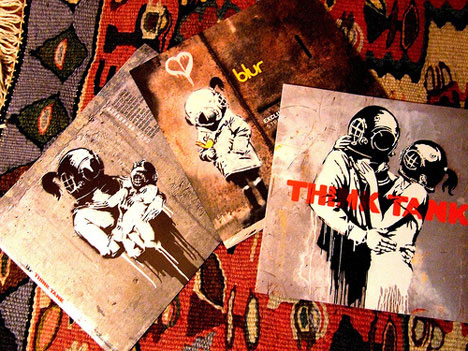
What's the problem with an artist who delivers a social message and actually gets paid for a quality product?
It's because there is no integrity in a gesture like hanging subverted artworks in MoMa, the Met and Brooklyn Museum when you have an enormously popular exhibit at the Bristol City Museum and Art Gallery. It's bad ass that Banksy strolls into galleries and nonchalantly hangs up his own work. However, he deplores the same museums and institutions in Wall and Piece as elitist, kultural manufacturing. Philosophy becomes a stunt when he then went on to display his own work. You could argue that this way he's getting a different message across in the galleries, but in actuality he's also generating revenue (crowds) to industries he allegedly despises.
This topic was broached when Banksy was featured as #129 on satirical site Stuff White People Like, which is basically like getting d-listed as an insipid producer of pop culture. Stuff White People Like disses Banksy on the grounds that he's not high faultin' enough and for the laypeople. The site points out that he's "anonymous, British, easy to understand, and he works in the medium of graffiti." On the contrary, Banksy's popularity gives him enormous potential as an artist in an incredibly visible position. Unfortunately, Banksy lost credibility because he became a commercial product and sold out. He destroys the intrinsic value of his own art by selling out to the highest bidders, a feat that contradicts the anti-capitalist ideals he expressed in graffito.

When speaking of Che Guevara in Wall and Piece, Banksy disclosed that he made the above piece because he didn't like these vendors who sold Che paraphernalia: mugs, t-shirts, fanny packs, etc. He wrote that he, "thinks [he] was trying to make a statement about the endless recycling of a cultural icon by endlessly recycling an icon." In other words, all the Che accessories denigrate the actual life of Che, the causes he supported and the alternatives he proposed. If you support Che or alternatives, buying a pencil case with their face on it is probably contradictory to their belief system. Right now, Banksy runs the risk of becoming some sort of graffiti mogul replete with gag gifts, customized license plates, or ironic tees. Graffiti does not belong in the gift shop at MoMA.
It should be a cityscape.
24.3.10
Banksy: Profiteer of the Village Green (1 of 2)
A graffito's form is a comment on the orientation of the individual within the local spatiality. It is arguably as much a guiding sign to use for navigating geographic locations as stop signs, mile-markers, or even the interactive, virtual maps like VEM or geotagging available on many smart phones. Attitudes toward graffiti tend to reflect how the individual's focalization upon the sign occurs in daily life. In other words, the long-standing debate surrounding graffiti, which basically questions whether it is a dynamic instrument of tactical art or miscreant vandalism, is framed within the visual position of the viewer and their relation to the community.
Simulacra and Strata
The distribution of spanning spray ultimately reflects your position within the infrastructure of city streets, the still-present rubble of New Orleans or even driving past initials and hearts spray-painted on a country bridge.
In the inner city, graffiti employs complex symbols and codes of representation that frequently allude to who's running those streets. Therefore, on the fundamental local level, it hails the pedestrians and occupants of the neighborhood and can provide them with a context denoting the territories of local gangs. Its second modicum would be to send a message to outsiders about the conditions within, including warnings or other signs where the user can decode according to their degree of familiarity with the locality.
As the train slips under the seemingly infinite, brick-armed bridges of Brooklyn, many of the outsiders never negotiate their motion through the space they're passing through. The semiotics are lost upon those passing through, the markings of the local culture are not relevant to their slow commutes home.
The layers of one's relationship with graffiti are innately complex, perhaps the most unbelievable permutation of this is demonstrated in the polemic relationship between the high-art-industry and the removal of graffiti from its original place. This is the ultimate defacement of graffiti, more so than the MTA's dedicated campaign and the media's criminalization of the art form. By making graffiti a commodity in the art world, it loses the deeper social implications it has as a billboard of public opinion, best understood in its local community.
By subjecting it to the standards of the art world, the locus is then upon the aesthetics of the form, not the intrinsic social message, which makes less of an impact the further away from its original space. Turning graffiti into high art becomes the most efficient means of neutralizing its political potency.
Then, there are those who still view graffiti as an act of vandalism that results in perpetuating what Jane Jacobs deemed 'the broken window theory.' Jacobs' hypothesized that physical signs, such as broken windows or poorly maintained homes, were symptoms of a larger problem. The unwillingness or inability of a homeowner to fix up their properties contributed not only to the decline of their home, but the value of other homes. She believed that one person's failure to invest in their homes signaled to others that they no longer had to exert the same effort to ensure the upkeep of their abodes. Overall, she predicted that this would cause a decline in the property values of the entire neighborhood.
Urban Planning Theories are Applied to the Framing of Litigation
Many governments have adopted these theories of sociopolitical concerns that suggest a decline in property values would also correlate to the presence of graffiti. Infamously, Rudy Giuliani of NYC adopted the attitude that graffiti was hazardous to communities on the grounds that it was a social act with negative consequences that resulted in a decline in property values. This, he deemed, made it a 'quality of life' crimes, or an action that had malevolent consequences for those concerned with the value of their real estate. In 1995, Title 10-117 forbade the distribution of aerosol spray-paint cans to youth less than 18 years-old. Stores also had to begin locking spray paint in glass displays behind the counter to discourage shoplifting. Businesses that would not adhere to these practices faced hefty fines for each sale.
Prime Minister Tony Blair has cracked down on graffiti, signing a bill that declared, "Graffiti is not an art, it's crime. On behalf of my constituents, I will do all I can to rid our community of this problem." British law enforcement went on to pass the "Anti-social Behaviour Act 2003," which gave officers the ability to penalize homeowners who allowed protective boards surround their property to be used as surfaces for graffiti, seeing that this essentially gave artists blank canvases to use and avoid spraying directly on houses.
As graffiti becomes more socially acceptable as an art form, the British government retaliates with increasingly outlandish charges. While Giuliani's laws are equally threatening in terms of their potential to silence tactile media of social protest, particularly youth voices, the UK has used invasive technology to apprehend graffiti artists and then prosecute them for conspiracy charges. On July 11th, 2008, the members of an artist collective, DPM, were sentenced with the Conspiracy to Commit Criminal Damage at Southwark Crown Court.
The members were charged with this offense after an extensive three-month surveillance operation by the British Transport Police. This task force deemed their efforts criminal endeavors to cause about £1 million in future damage. As a result of this decision, five members of the group were imprisoned. While damaging public property is illegal and the artists could have used other means like impermanent paint, the actions of the BTP demonstrate a refusal of the organization to view the potential of graffiti as act of social empowerment.
 In addition, the unpopular hyper-surveillance of the government is often the subject of graffiti murals (left: a Banksy spy-ninja-rat). Prosecuting graffiti artists with the same technology they are protesting proves that graffiti is a political statement. Much of the work of Banksy, for instance, encompasses the theme of the eroding place of the private individual in a public state that uses technology as an agent of social control.
The justification for the Big Brother stance is that it is a means of protecting the British public from terrorists. As recently as March 24th, 2009, Cory Doctorow on Boing Boing covered the ludicrousness of a Metropolitan Police press release found here. The main goal of the campaign appears to be fostering fear in its citizens under the guise of security. It's a mass-indoctrination campaign aimed to make individuals feel pressure to 'out' those suspected of aiding and abetting terrorist activities.
The press release that Doctorow discusses explicitly says that Londoners should "go through each others' trash-bins looking for 'suspicious' chemical bottles" and to even tattle on anyone who 'stud[ies] the CCTV cameras." For those unaware of the sweeping changes in Britain, there are millions of cameras installed around London to combat terrorism while giving its citizens no option to avoid having their most minute gesture recorded. The individual is not in charge of the distribution of the film and, as stated in the press materials, is encouraged to know as little as possible about the camera, to know is to be impugned with guilt.
What makes this campaign the most paradoxical is how inefficient the cameras are at their intended function: solving crimes. BBC News ran a story covering a study that revealed, "Only one crime was solved by each 1,000 CCTV cameras in London last year." This prompted David Davis MP to suggest that the data "should provoke a long overdue rethink on where the crime prevention budget is being spent." Apparently, the inefficiency of the cameras is being downplayed in favor of heightening the atmosphere of terror and appealing to the old guard by having flashy trials with 'miscreant' graffiti artists.
In tandem, this campaign upped its efforts and hoped to even "utilise... London specific media: radio and press, posters at the tube and rail stations" to maintain the clime of fear. The slogan of the campaign is "Don't rely on others. If you suspect it, report it" and this is frequently accompanied with propaganda and used for the purpose of heightening the country's awareness of the 'Confidential Anti-Terrorist Hotline.' The entire situation is uncannily similar to the Orwellian sci-fi depiction of a future British state in the movie Brazil. One of the more laughable posters depicts the back of an older woman looking at a CCTV camera near a crowded public area in a recent report.
The accompanying caption reads, "A bomb won't go off here because weeks before a shopper reported someone studying the CCTV camera." The shopper is the model citizen, not only helping London's economy with their purchases, but by cooperating with their anti-terrorism campaigns. The vigilant paranoia and fear-mongering atmosphere is glorified by this propaganda featuring the best-case-scenario outcome. What if someone reports an elderly blind man tipping his head in the direction of the cameras? What if tourists gape at the cameras?
Obviously, the ramifications of this ill-applied campaign are that they evoke more terror and distrust among British citizens that actual terrorists could probably achieve. One means of resisting the intrusion of video cameras and surveillance equipment into the public arena is to decorate, say, CCTV towers with fake pigeons and a pirate flag.
Resisting the intrusion of video cameras and surveillance equipment into the public with artistic repartee is one of the reasons why graffiti artist Banksy is a darling of public opinion. His mass appeal comes from how many of his stencil-based works in Brixton and London depict rats, crows and monkeys getting caught up in surveillance equipment. One of his street art installation featured two crows and a pirate flag installed right under a CCTV camera. He's also fond of subverting pictures of classical landscapes with the Big Brother cameras looking over all.
Banksy's public commentary, ranges from the anti-anti-terrorism movement to his opposition pieces protesting UK involvement in Iraq. They have brought the concerns of these communities to the forefront of their public squares and village greens. Banksy may have, however, established the best marketing strategy of any anti-establishment artist to date.
(Continued in second post)
Jennifer Sussex has been featured in The Village Voice, The Chicago Tribune, PBS Student Voices: Washington Week, Our Young Art, The Gargoyle and The Michigan Daily. All material on this site is subject to licensing under the Creative Commons.
Simulacra and Strata
The distribution of spanning spray ultimately reflects your position within the infrastructure of city streets, the still-present rubble of New Orleans or even driving past initials and hearts spray-painted on a country bridge.
In the inner city, graffiti employs complex symbols and codes of representation that frequently allude to who's running those streets. Therefore, on the fundamental local level, it hails the pedestrians and occupants of the neighborhood and can provide them with a context denoting the territories of local gangs. Its second modicum would be to send a message to outsiders about the conditions within, including warnings or other signs where the user can decode according to their degree of familiarity with the locality.
As the train slips under the seemingly infinite, brick-armed bridges of Brooklyn, many of the outsiders never negotiate their motion through the space they're passing through. The semiotics are lost upon those passing through, the markings of the local culture are not relevant to their slow commutes home.
The layers of one's relationship with graffiti are innately complex, perhaps the most unbelievable permutation of this is demonstrated in the polemic relationship between the high-art-industry and the removal of graffiti from its original place. This is the ultimate defacement of graffiti, more so than the MTA's dedicated campaign and the media's criminalization of the art form. By making graffiti a commodity in the art world, it loses the deeper social implications it has as a billboard of public opinion, best understood in its local community.
By subjecting it to the standards of the art world, the locus is then upon the aesthetics of the form, not the intrinsic social message, which makes less of an impact the further away from its original space. Turning graffiti into high art becomes the most efficient means of neutralizing its political potency.
Then, there are those who still view graffiti as an act of vandalism that results in perpetuating what Jane Jacobs deemed 'the broken window theory.' Jacobs' hypothesized that physical signs, such as broken windows or poorly maintained homes, were symptoms of a larger problem. The unwillingness or inability of a homeowner to fix up their properties contributed not only to the decline of their home, but the value of other homes. She believed that one person's failure to invest in their homes signaled to others that they no longer had to exert the same effort to ensure the upkeep of their abodes. Overall, she predicted that this would cause a decline in the property values of the entire neighborhood.
Urban Planning Theories are Applied to the Framing of Litigation
Many governments have adopted these theories of sociopolitical concerns that suggest a decline in property values would also correlate to the presence of graffiti. Infamously, Rudy Giuliani of NYC adopted the attitude that graffiti was hazardous to communities on the grounds that it was a social act with negative consequences that resulted in a decline in property values. This, he deemed, made it a 'quality of life' crimes, or an action that had malevolent consequences for those concerned with the value of their real estate. In 1995, Title 10-117 forbade the distribution of aerosol spray-paint cans to youth less than 18 years-old. Stores also had to begin locking spray paint in glass displays behind the counter to discourage shoplifting. Businesses that would not adhere to these practices faced hefty fines for each sale.
Prime Minister Tony Blair has cracked down on graffiti, signing a bill that declared, "Graffiti is not an art, it's crime. On behalf of my constituents, I will do all I can to rid our community of this problem." British law enforcement went on to pass the "Anti-social Behaviour Act 2003," which gave officers the ability to penalize homeowners who allowed protective boards surround their property to be used as surfaces for graffiti, seeing that this essentially gave artists blank canvases to use and avoid spraying directly on houses.
As graffiti becomes more socially acceptable as an art form, the British government retaliates with increasingly outlandish charges. While Giuliani's laws are equally threatening in terms of their potential to silence tactile media of social protest, particularly youth voices, the UK has used invasive technology to apprehend graffiti artists and then prosecute them for conspiracy charges. On July 11th, 2008, the members of an artist collective, DPM, were sentenced with the Conspiracy to Commit Criminal Damage at Southwark Crown Court.
The members were charged with this offense after an extensive three-month surveillance operation by the British Transport Police. This task force deemed their efforts criminal endeavors to cause about £1 million in future damage. As a result of this decision, five members of the group were imprisoned. While damaging public property is illegal and the artists could have used other means like impermanent paint, the actions of the BTP demonstrate a refusal of the organization to view the potential of graffiti as act of social empowerment.
 In addition, the unpopular hyper-surveillance of the government is often the subject of graffiti murals (left: a Banksy spy-ninja-rat). Prosecuting graffiti artists with the same technology they are protesting proves that graffiti is a political statement. Much of the work of Banksy, for instance, encompasses the theme of the eroding place of the private individual in a public state that uses technology as an agent of social control.
The justification for the Big Brother stance is that it is a means of protecting the British public from terrorists. As recently as March 24th, 2009, Cory Doctorow on Boing Boing covered the ludicrousness of a Metropolitan Police press release found here. The main goal of the campaign appears to be fostering fear in its citizens under the guise of security. It's a mass-indoctrination campaign aimed to make individuals feel pressure to 'out' those suspected of aiding and abetting terrorist activities.
The press release that Doctorow discusses explicitly says that Londoners should "go through each others' trash-bins looking for 'suspicious' chemical bottles" and to even tattle on anyone who 'stud[ies] the CCTV cameras." For those unaware of the sweeping changes in Britain, there are millions of cameras installed around London to combat terrorism while giving its citizens no option to avoid having their most minute gesture recorded. The individual is not in charge of the distribution of the film and, as stated in the press materials, is encouraged to know as little as possible about the camera, to know is to be impugned with guilt.
In tandem, this campaign upped its efforts and hoped to even "utilise... London specific media: radio and press, posters at the tube and rail stations" to maintain the clime of fear. The slogan of the campaign is "Don't rely on others. If you suspect it, report it" and this is frequently accompanied with propaganda and used for the purpose of heightening the country's awareness of the 'Confidential Anti-Terrorist Hotline.' The entire situation is uncannily similar to the Orwellian sci-fi depiction of a future British state in the movie Brazil. One of the more laughable posters depicts the back of an older woman looking at a CCTV camera near a crowded public area in a recent report.
The accompanying caption reads, "A bomb won't go off here because weeks before a shopper reported someone studying the CCTV camera." The shopper is the model citizen, not only helping London's economy with their purchases, but by cooperating with their anti-terrorism campaigns. The vigilant paranoia and fear-mongering atmosphere is glorified by this propaganda featuring the best-case-scenario outcome. What if someone reports an elderly blind man tipping his head in the direction of the cameras? What if tourists gape at the cameras?
Obviously, the ramifications of this ill-applied campaign are that they evoke more terror and distrust among British citizens that actual terrorists could probably achieve. One means of resisting the intrusion of video cameras and surveillance equipment into the public arena is to decorate, say, CCTV towers with fake pigeons and a pirate flag.
Resisting the intrusion of video cameras and surveillance equipment into the public with artistic repartee is one of the reasons why graffiti artist Banksy is a darling of public opinion. His mass appeal comes from how many of his stencil-based works in Brixton and London depict rats, crows and monkeys getting caught up in surveillance equipment. One of his street art installation featured two crows and a pirate flag installed right under a CCTV camera. He's also fond of subverting pictures of classical landscapes with the Big Brother cameras looking over all.
Banksy's public commentary, ranges from the anti-anti-terrorism movement to his opposition pieces protesting UK involvement in Iraq. They have brought the concerns of these communities to the forefront of their public squares and village greens. Banksy may have, however, established the best marketing strategy of any anti-establishment artist to date.
(Continued in second post)
Jennifer Sussex has been featured in The Village Voice, The Chicago Tribune, PBS Student Voices: Washington Week, Our Young Art, The Gargoyle and The Michigan Daily. All material on this site is subject to licensing under the Creative Commons.
1.3.10
What White America Reads: The Harlequin Intrigue Series
 If you wander down the leisure reading aisle of Meijer's, a Michigan grocery franchise, be prepared to encounter a slice of midsection from good 'ole American tenderloin. As a liberal arts grad, I always thought of romance novels as the only kind of airport fiction worse than chick lit. I didn't understand why the clichés and derivative plot-lines aren't worthy of the kitsch factor, like a dime store novel. I didn't see how there could be nothing funny about a stock character named Desmond who fights fires shirtless. I had to know; who reads romance novels? Does anyone take them seriously?
To figure it out, I cut the book snobbery and decided to spend some time looking at the layout of the Meijer's book display. The selection at the grocery store carried lines of books named Harlequin Intrigue, Harlequin Teen, Harlequin American Romance (above) and even Harlequin NASCAR
I've never seen that much purple vomit in my life. I later learned that there was a reason behind the ubiquity of the covers. Harlequin Enterprises aims for mass series sales, not pushing individual books or authors. Where popularity or talent would otherwise garner the most amount of money the company spends on advertising, Harlequin instead emphasizes lines of titles are emphasized in the book design.
Indirectly, it encourages the writers to aspire to adhesiveness to a genre rather than personal innovation. Buying a romance novel, then, is purchasing an over-arching ideology. It's like identifying with a lifestyle brand. Welcome to the City Generica; how do you take your product placement? Do you want it supersized? Pepsi or Coke?
From the Drug Store to the Subsidiary
During the last seventy-five years, women's erotica has undergone a transformation, which is directly related to the discrimination and challenges women writers faced being published. It's difficult to imagine being a female writer trying to get an advance for a book, let alone one containing an explicit sex scene. No matter how dated they may seem now, writers like Anaïs Nin and Kate Chopin were truly pioneers of this genre. Nin was one of the first women to write about incest with the publication of Winter of Artifice in 1939.
The Awakening might be tame enough to be on high school reading lists, but the fact that it was published in 1899 is incredible. As someone born almost three decades after the Sexual Revolution of the '60s, it's hard to imagine a bookstore or culture without Playboy or the concept of an adult section.
Women's erotica changed with increasing social liberalism and the repeal of censorship laws. Harlequin Enterprises was actually once a publisher founded in Winnipeg in 1949 that didn't even publish sex scenes. The Jane Austen-like plot twists ended modestly, with the couples kissing passionately and promises of marriage. The books paled in comparison to the writing of, say, Nin who was publishing stories about accompanying the equally infamous Henry Miller to Parisian brothels during WWII.
Eventually, sales for Harlequin dropped when they faced the steamier competition from other publishing houses after Lawrence Ferlinghetti's acquittal in the Howl obscenity trial. One of Harlequin's main competitors was a publishing house with the unfortunate namesake of Candlelight Ecstasy. Nomenclature aside, by 1983, Candleight Ecstasy was generating sales of about $30 million. Harlequin eventually acquired the parent company of this line, Silhouette. This meant that Harlequin Enterprise owned 85% of the romance market in the early 1990s. Enter genre fatigue.
With an estimated revenue of approximately $585 million according to an August 2004 New York Times interview, the subsidiary's parent corporation Torstar is Canada's most lucrative publisher. There are over a thousand writers, over a hundred novels published monthly and in almost thirty languages: the Harlequin romance novel might be scorned by literary snobs, but this genre provides a mass market at a time when newspaper media reaches the juncture to either go digital or disappear. No matter how laughable you find romance novels, the massive consumer base and articulation of America within these passages speaks significantly about pop culture.
Stuck in City Generica Traffic
The demand for romance novels is not as gendered as one might think. In 1991 in Hungary, for example, Harlequin sold 11 million books and there are only 5.5 million women in the country. Based on information from the Romance Writers of America site, men make up 9.5 percent of the readership. No individuals who identify themselves as transgendered, apparently, were surveyed. The site also cites, "the heart of the U.S. romance novel readership is women aged 31–49 who are currently in a romantic relationship." The teen novels are basically Twilight knock-offs and all the names sound like characters from Eragon or Lord of the Rings.
Part of the general homogeneity of the genre occurs because geographic location is one of the key factors that allows publishing houses to mass produce their paperbacks. According to Romance Writers of America, the percent of individuals who read romance novels in certain locations ends up breaking down into an sales infograph available on their site:

Like any successful corporate conglomerate, Harlequin also invested in overseas markets. When a book is sold in another country, the regionally distinct elements of a story essential to their branding in America are removed. The formula for addressing cross-cultural boundaries is simply; change location or regional specific names, customs, or metaphors.
Not only are the plots formulaic, but the books exists within a derivative structure that promotes the ultimate ubiquity. While this arguably can be seen as a promotion of cultural monotheism, it is mostly the result of the burgeoning international market for Harlequin Enterprises. After all, the subsidiary has offices on nine continents and is published in 29 different languages, according to the Harlequin Enterprises' Wikipedia.
The Harlequin American Romance Series and Wanted: One Mommy
Wanted: One Mommy hearkens the values of capitalism with an oil tycoon and part-time single dad not actively looking for love. The cover for this book (top left) is pretty much what all the covers looked like. To briefly judge some books by their covers:
- Ninety-nine percent of the covers of the books featured lovers that were white
- None pictured any interracial pairings or anything not one-man-one-woman
- The men in the books are homogeneously 'tall, dark and handsome'
- The men on the covers usually had less clothing on than the women
- The women were usually Nordic-looking with few brunettes
When one considers that the amount of education a person has is largely proportionate to income stratification, the majority of this audience is likely working or lower-middle class in terms of the income brackets. The whole marketing scheme of the industry is designed to 'speak to' and reach this demographic, which much like the Republican party, caters to the social values of Americans with low socioeconomic status while subsuming them in fantasy, taking their money and creating something like Capitalist Stockholm Syndrome.
One enumerating example of this can be found on the back blurb for Caroline Mayer's Wanted: One Mommy. The jacket reads,
Jack Gaines (Gaines, like money, get it?) is white, southern and a Texas oil tycoon. The construction southern American identity, here, is interesting. Gaines is a mythical figure who strikes it rich mining by the natural resources of the south. The regional lore reaffirms southern identity, but at the cost of maintaining a world that is racially exclusive and restricted by traditional gender roles.
Caroline Mayer has made a successful career out of planning everybody's wedding but her own. But this is the first time she's been asked to stop one!
Jack Gaines is certain his mother's impending nuptials are a big mistake. The take-charge CEO is too smart to believe in happy endings. His matchmaking mom and young daughter don't agree! And his instant attraction to Caroline is making the single father wonder if he's really a romantic at heart after all.
Caroline never planned on falling in love with Jack's family. And now his lively little girl is making her think twice about putting her own dreams of motherhood on hold.
Chemistry aside—is Caroline ready to trust her future to one stubborn, overprotective, utterly irresistible Texan?
 The heroine in the novel, Caroline Mayer, is underemployed and working as a wedding planner. Her job is to essentially be responsible for crafting and celebrating the continuance of marriage within the community. The oil tycoon is a widower who is too pragmatic for romance, but Sweet Caroline prevails by her skill at homemaking. This book is not about infidelity, but the preservation of marriages and traditional mores. If Sweet Caroline excels at domesticity, then she gets her guy and the unstated benefit of that is the implied financial security.
It was actually painful to write that synopsis.
A Nod to the Culture Industry
Literotica reaffirms the class and regional customs that ultimately damage those who believe in them the most. The 'money shot,' if you will, of a romance novel is not the sexual gratification of the protagonists. It's the fantasy that sexuality allows the characters to achieve class mobility during the middle of an economic depression when this specific audience faces the most hardship.
While teaching the mass public how to be model citizens and consumers in a parasitic society, the Harlequin American Romance series does nothing to humanize America's untouchables: the working class. They do nothing to lend credibility to the people featured in succinct publications like Time magazine that constitute a populace comprised of 'Main Street' and 'Wall Street.' The Harlequin American Romance series is part of a larger problem within the literary and news world.
In a culture where the upper classes create the highest amount of media due to their greater amount of leisure time, those portrayals of working class Americans are as stereotypical as these novels. American accounts of the Iraq War or 'life at home' are nothing more than a voyeuristic exploitations of the lives of the socioeconomically less privileged. The spatial and ideological separation of American social classes means that we learn about the lives of other people through the box, the print and the camera lens. The structure that produces this information is biased because the perspective of art is intertwined with money.
Gimme free culture.
Jennifer Sussex has been featured in The Village Voice, The Chicago Tribune, PBS Student Voices: Washington Week, Our Young Art, The Gargoyle and The Michigan Daily. All material on this site is subject to licensing under the Creative Commons.
26.2.10
Metro Card for Dash Snow

Elements of a visual garden collage include, but are not limited to: Antique, Italian chess set belonging to the nefarious Matt Grogan, foliage from the tree-line at 57 Central Park South juxtaposed against the sights from waiting waiting at the 96th Street station to leave Heather and Sal's places and all wrapped together for a consummate portrayal of spherical time.
There's also an excerpt from last summer's Times chronicling the public's death-romance with young, 'blighted' arts like Snow, pieces of the 110th Street mural in pastel, and the ovalness of motion coming from the sleek frames of that car always parked on 12th Street. Many types of peripatetic vibrations disrupted the digest of my thoughts, which I felt as the flyaway bangs stick to my face in the humidity of a hot wind down a muggy tunnel. I was always wiping it out of my eyes. One day, one little opossum at looks up at me long enough for me not to mistake it for a rat. Dash Snow: you are a brand as well-suited for a museum in a Wes Anderson flick, which you would have abhorred by default, you fucking fink.
Jennifer Sussex has been featured in The Village Voice, The Chicago Tribune, PBS Student Voices: Washington Week, Our Young Art, The Gargoyle and The Michigan Daily. All material on this site is subject to licensing under the Creative Commons.
Subscribe to:
Posts (Atom)

 Posts
Posts


